GIN PALMA - VODKA
THE GUARDIAN
ITALIANODi notte, quando il mare sotto Pollina si fa scuro come inchiostro e la costa smette di essere soltanto terra per diventare confine, si dice che una figura vegli ancora sull’isola.
Non è una santa, non è un fantasma, non è una regina caduta.
È la Guardiana.
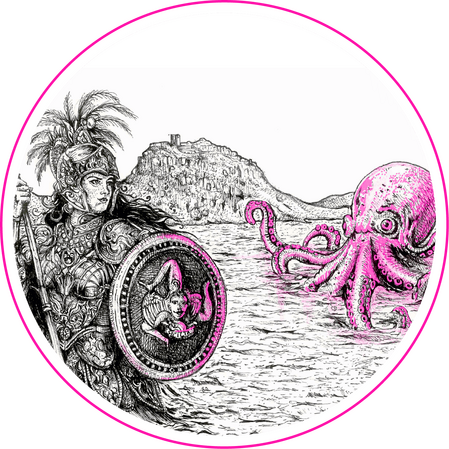
Sta immobile sul bordo del mondo, davanti al promontorio, con lo sguardo rivolto al mare aperto. Alle sue spalle, Pollina appare lontana e sospesa, come un luogo antico da proteggere, una rocca preziosa che il tempo non ha consumato. Davanti a lei, invece, c’è soltanto il Mediterraneo: vasto, seducente, inquieto.
La Guardiana non fugge e non attacca.
Presidia.
Nel suo scudo porta la Trinacria, non come ornamento ma come segno vivo di appartenenza. È la memoria dell’isola fatta difesa, la storia trasformata in forza, la radice che diventa arma silenziosa. In quel gesto fermo c’è tutta la Sicilia: orgogliosa, regale, indomabile. Una terra che non chiede di essere salvata, ma riconosciuta nella sua potenza.
Dal mare, però, qualcosa sale sempre.
Una creatura enorme, un polpo emerso dagli abissi, avanza tra le onde come incarnazione del caos: la minaccia che non ha volto, la pressione del fuori, la tempesta che ogni isola conosce. Ma non è solo pericolo. In quella creatura vive anche il fascino oscuro del Mediterraneo, la sua energia notturna, il desiderio, l’eccesso, la vertigine.
È in quell’istante che il mondo cambia colore.
Tutto ciò che appartiene alla terra resta inciso in bianco e nero: netto, severo, reale.
Ma ciò che appartiene alla leggenda si accende di magenta fluo. La luna, le fiamme, il corpo della creatura: presenze soprannaturali che rompono il rigore dell’incisione antica e lo trasformano in visione contemporanea, quasi elettrica, quasi urbana. Come se il mito, invece di appartenere al passato, si risvegliasse nel presente con l’intensità di un neon nella notte.
Così la scena non racconta una battaglia, ma un dominio.
La Guardiana non teme il mostro.
Lo guarda.
Lo contiene.
Lo trasforma.
Perché questa non è la storia di una Sicilia assediata, ma di una Sicilia sovrana, capace di convertire il pericolo in potere, il caos in presenza, la notte in segno. Una terra fredda e magnetica, pura e feroce, che resta immobile mentre tutto intorno si agita.
Ed è proprio da questa visione che nasce la vodka:
limpida come la luna, tagliente come l’aria sul promontorio, ipnotica come il mare quando si accende nel buio.
Non una semplice bottiglia, ma un emblema.
Non un’illustrazione, ma una soglia.
La leggenda dice che la Guardiana è ancora lì.
E che ogni volta che il mare prova a prendere, lei ricorda all’orizzonte a chi appartiene questa isola.
ENGLISHAt night, when the sea below Pollina turns as dark as ink and the coastline ceases to be merely land and becomes a border, it is said that a figure still keeps watch over the island.
She is not a saint, not a ghost, not a fallen queen.
She is the Guardian.
She stands motionless at the edge of the world, before the headland, her gaze fixed on the open sea. Behind her, Pollina appears distant and suspended, like an ancient place to be protected, a precious stronghold that time has not worn away. Before her, there is only the Mediterranean: vast, seductive, restless.
The Guardian neither flees nor attacks.
She stands watch.
On her shield she bears the Trinacria, not as an ornament but as a living sign of belonging. It is the island’s memory made into defense, history transformed into strength, the root turned into a silent weapon. In that steady gesture lies all of Sicily: proud, regal, untamable. A land that does not ask to be saved, but to be recognized in its power.
And yet, from the sea, something always rises.
A monstrous creature, an octopus emerging from the abyss, advances through the waves as the embodiment of chaos: the threat with no face, the pressure of the outside world, the storm every island knows. But it is not only danger. Within that creature also lives the dark allure of the Mediterranean, its nocturnal energy, desire, excess, vertigo.
It is in that instant that the world changes color.
Everything that belongs to the land remains etched in black and white: stark, severe, real.
But everything that belongs to legend ignites in fluorescent magenta. The moon, the flames, the creature’s body: supernatural presences that break the rigor of the ancient engraving and transform it into a contemporary vision, almost electric, almost urban. As if myth, instead of belonging to the past, were awakening in the present with the intensity of a neon light in the night.
And so the scene tells not of a battle, but of dominion.
The Guardian does not fear the monster.
She looks at it.
She contains it.
She transforms it.
Because this is not the story of a Sicily under siege, but of a sovereign Sicily, capable of turning danger into power, chaos into presence, night into symbol. A land both cold and magnetic, pure and fierce, that remains still while everything around it stirs.
And it is precisely from this vision that the vodka is born:
clear as the moon, sharp as the air on the headland, hypnotic as the sea when it lights up in the dark.
Not a simple bottle, but an emblem.
Not an illustration, but a threshold.
Legend says that the Guardian is still there.
And that every time the sea tries to take, she reminds the horizon to whom this island belongs.